

The draft comes back close, but not quite. So you type what most of us type: “make it nicer” Or “more premium” Or “less AI-looking” What comes back is different, not better. So you type it again.
“Nicer” means something specific to you: a color, a weight, a kind of quiet. To the agent it can mean a dozen things, and it doesn’t average them. It picks one, and you don’t know which.
“Nice” isn’t feedback. “Nice” is a feeling. Feedback is a definition.
The last issue was about the brief, what you tell an agent before the work. This one is about what you say after you see it. Same job, take the guesses out, except now the result is in front of you and your gut talks first.
Turning a feeling into a decision is the manager’s part of the job, and you can’t hand it to the agent, because the feeling is yours. Five questions turn it into something the agent can act on.
Where, what, why, instead, test
Where
Which exact spot?
The quoted sentence, the selected element, the second in the video, the slide number. A model that can’t find its own mistake will usually fix it once you say where it is.
What
What standard does it miss?
A gap the agent can check itself against, not an adjective it has to guess. “Too long” is a feeling. “Two hundred words, and the limit is a hundred and fifty” is a standard.
Why
Why does it matter?
One clause. The reason is what lets the agent apply the fix to the cases you didn’t mention.
Instead
What did you want?
The sentence you’d write, the example, the reference image. Show the target, not just the miss.
Test
How will we both know it’s fixed?
Something that can fail: a word count, a screenshot next to the reference, a test that runs. Without it, “looks done” is the only signal. And don’t hand this part to another AI: in a 2026 study, AI judges often couldn’t tell whether a revision had actually taken the feedback.
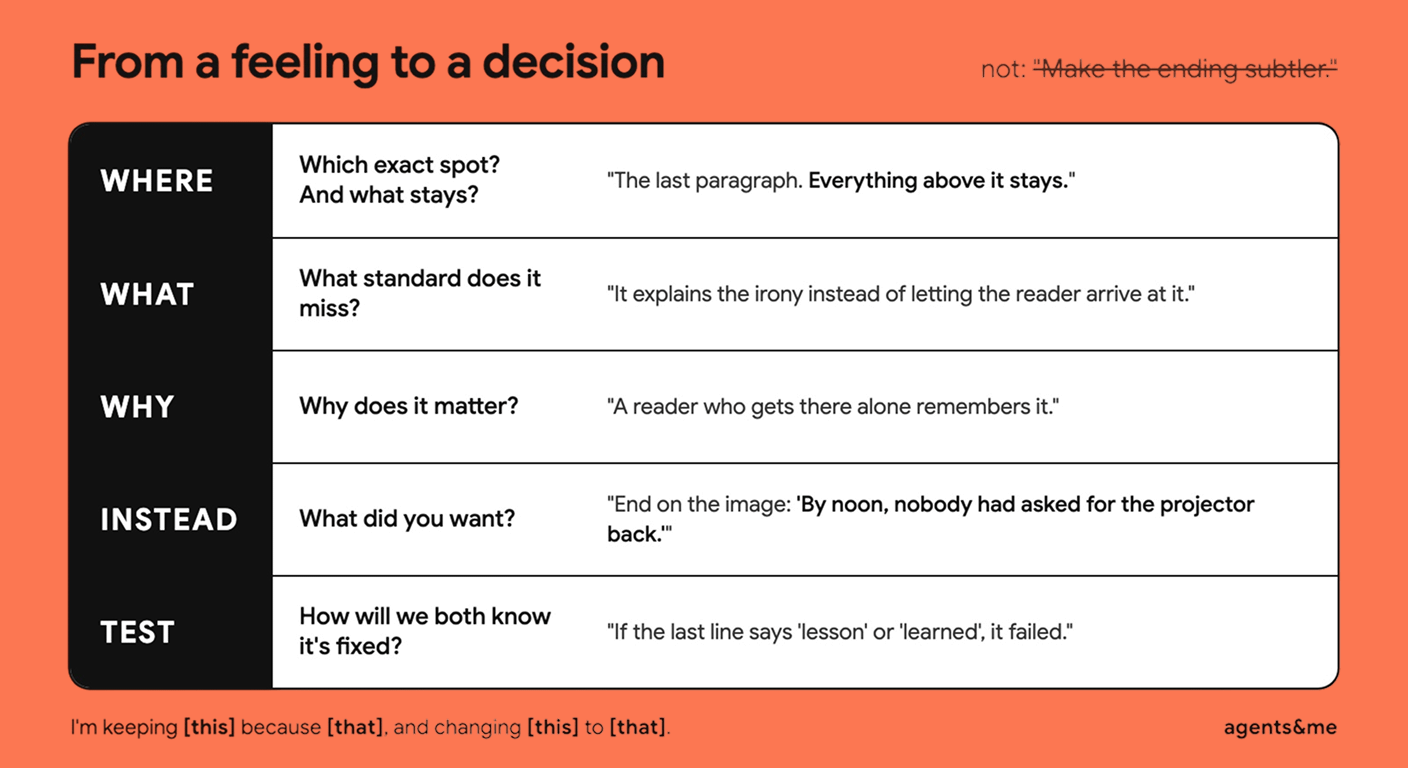
One note, five steps
Take an invented one. An agent drafted a LinkedIn post about a team offsite where the projector died and the group did its best work without slides. You read the ending and type the note most of us would:
“The ending is too preachy. Make it subtler”
Now add one part at a time.
Where. “The last paragraph, from ‘The lesson here is’. Everything above it stays, including the opening line about the projector.”
What. “It explains the irony instead of letting the reader arrive at it.”
Why. “A reader who gets there alone remembers it. A reader who is told keeps scrolling.”
Instead. “End on the image and stop: ‘By noon, nobody had asked for the projector back.’”
Test. “Show me the last line alone. If it says ‘lesson’, ‘learned’ or ‘the point is’, it failed.”
“Preachy” was a feeling. “Explains the irony” is a standard the agent can hold its next draft against.
Five parts isn’t a long message. Each part is a line, sometimes half of one. It takes a minute longer than “make it subtler,” and that minute is where you decide what you actually want.
The half of Where everyone skips
Notice the second sentence of the Where: “Everything above it stays.”
Ask for one change and you often get three you didn’t ask for, because nothing told the agent which parts were done. Then you’re chasing a version you liked three messages ago. The simplest fix I know is one sentence:
I’m keeping [this] because [that], and changing [this] to [that].
Why it matters more with an agent
A colleague who thinks they’re right pushes back. An agent mostly won’t. It has no ego to protect, but it has a trained reflex to agree. I put it this way to one of our graduates: there’s something broken in AI, the moment it realizes an idea is its owner’s, it agrees right away.
That reflex turns two ordinary replies into steering.
Your doubt is an instruction. In a study by Anthropic researchers, one “I don’t think that’s right. Are you sure?” was enough to make models change their answers. Even the most stubborn, GPT-4, changed a correct first answer about a third of the time.
Those were 2023 models. The reflex hasn’t gone away: in Anthropic’s own 2026 measurement of personal-advice conversations, its models agreed too readily 18 percent of the time when the user pushed back, against 9 percent when they didn’t.
Pushback that sounds more certain, or cites a source, makes it worse. So if you’re not sure the agent is wrong, don’t ask if it’s sure. Bring the evidence, or ask for it: “show me the row this number came from,” “run the test.” Or open a fresh chat, paste both versions without saying which is yours, and ask which holds up.
Your compliment is a signal. “Love it” tells the agent to keep doing more of what it just did, without saying which part you loved. At scale it gets worse. In 2025 OpenAI rolled back a model that flattered everyone, and thumbs-up data was part of the cause.
Vague praise is the problem. Say which part was good, so it stays, the same way the keeping sentence above names what stays.
With a colleague, feedback is an opinion. With an agent, every reply steers.

Early, and clean
Give it while the work is cheap. I don’t need to approve every step. I need to see the decision that will be expensive to change later: the direction before the draft, the outline before the article, the still frame before the animation.
On the third round, start clean. Corrected the same point twice and it’s still wrong? Stop. Ask the agent for a short brief of everything you’ve settled, open a new chat, and start from that. In Anthropic’s guidance for Claude Code: “A clean session with a better prompt almost always outperforms a long session with accumulated corrections.”
My own tape
I’m not writing this as someone who has it solved.
Alan, the agent on my team who gives me notes on how I manage the others, keeps a ledger of my feedback. When I do write a correction, it says, it carries the spot and the fact. It also showed me, in October, that I skipped the why exactly when it mattered most: when I overruled my team. Six creative recommendations, I overruled all six, and five had no reason of mine on file.
My team could see what I chose. They couldn’t see why, so next time they’d guess. And a why that lives only in a chat is gone when the window closes. The ones that last are the ones written into the agent’s instructions.
Your next correction
Next time your fingers start typing “make it better,” stop and add one thing, the where, because it’s the part that moves the most.
When that’s a habit, add the test.
If you’d rather have the agent hold you to it, put one line in its instructions: “When my feedback has no where or no test, ask me for them before you change anything.”
Then reply with one note you rewrote, before and after. Mine usually miss the why.
That’s it for this week.
If this was useful, forward it to someone who typed “make it better” today.
See you next week ✌️
Tom
P.S. My team drafted this from the research we did in October on how models respond to feedback.
P.P.S In the workshops we learn how to close the loop and help agents learn & improve from our feedback.
P.P.P.S. If you missed the brief half, it’s GO ABC.