

You’ve written a version of it, probably something like “write me a better email”. What comes back is good enough: fluent, on topic, and not quite what you meant. So you fix it, ask again, and fix it again.
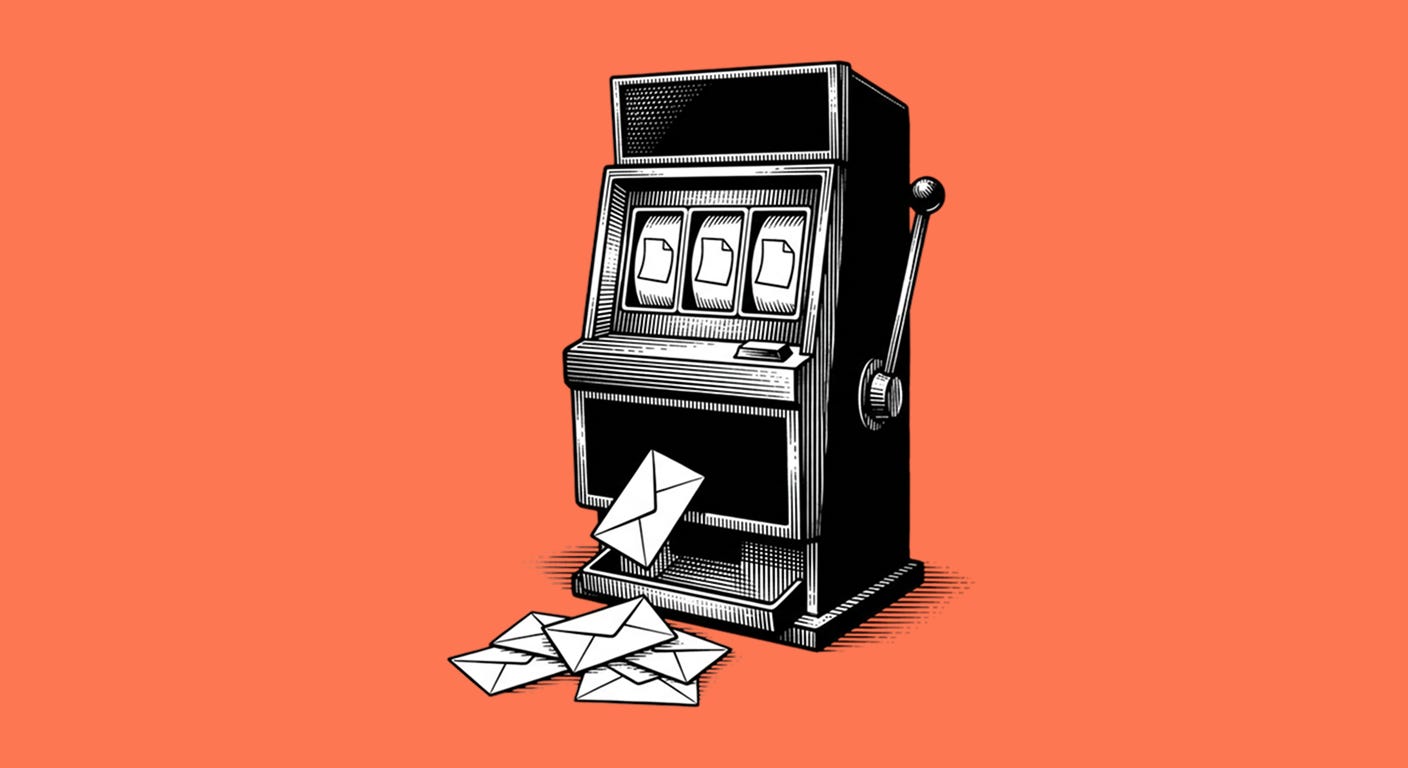
I call it “slot machine prompting”: one line in, pull the lever, see what comes out, pull again.
Most of the time the problem starts before the agent writes a word. A one-line brief doesn’t say what the email is for, who will read it, what’s off limits or what was tried last time. The agent fills every gap with its most likely guess, and the most likely guess is average.
A few minutes on the brief saves a lot of pulls later. More important, it’s how you get what you meant instead of something close to it.
GO ABC
This is the “Tell the intent” step from the last issue, on taste, opened up. A good brief answers five questions. The first four come from what Anthropic asks of its own research agents; C is mine, and so are the why in G and the finish line in O.
G: Goal
What are we trying to achieve, and why?
Explain the purpose behind the task. Instead of “Write a landing page”, try “Write a landing page that helps first-time visitors understand the product and decide whether to book a demo.”
The better the agent understands the destination, the more freedom it has to find a good way there.
~ ~ ~
O: Output
What exactly should be delivered, and what does “done” look like?
Describe the thing you expect to receive, and include the finish line. Instead of “Give me some ideas”, try “Give me five headline options. Each should be under 10 words, clearly communicate the value proposition, and be different enough that I can choose between distinct directions.”
Output is the thing plus the finish line, and “works perfectly” isn’t one.
~ ~ ~
A: Assets
What does the agent have to work with?
Files, data, examples, references, previous work, brand guidelines, research, screenshots, tools, source material.
Don’t make someone rediscover information you already have.
~ ~ ~
B: Boundaries
Where are the walls, and what does the agent decide alone?
Good boundaries show an agent where its creativity is useful:
Keep the existing positioning.
Don’t change the pricing.
You may completely rethink the structure and copy.
Pick the structure yourself. Bring me the headline before you write the rest.
Don’t publish anything without approval.
Say both halves: what comes back to you first, and what the agent decides on its own.
~ ~ ~
C: Context
What would a smart new hire get wrong if nobody told them?
Put that here. Context is whatever could change the quality of the work, and is obvious to you but not to someone new: who the audience is, what happened before, why this matters now, what has already been tried. And what you personally like or dislike. A new hire can’t guess that one.
Two briefs, before and after
Both are invented for teaching, numbers included. The test I hold each one against comes from Alan, the agent on my team who gives me notes on how I manage the others: the before describes a feeling, and the after describes a destination the agent can check itself against.
1. The nice letter
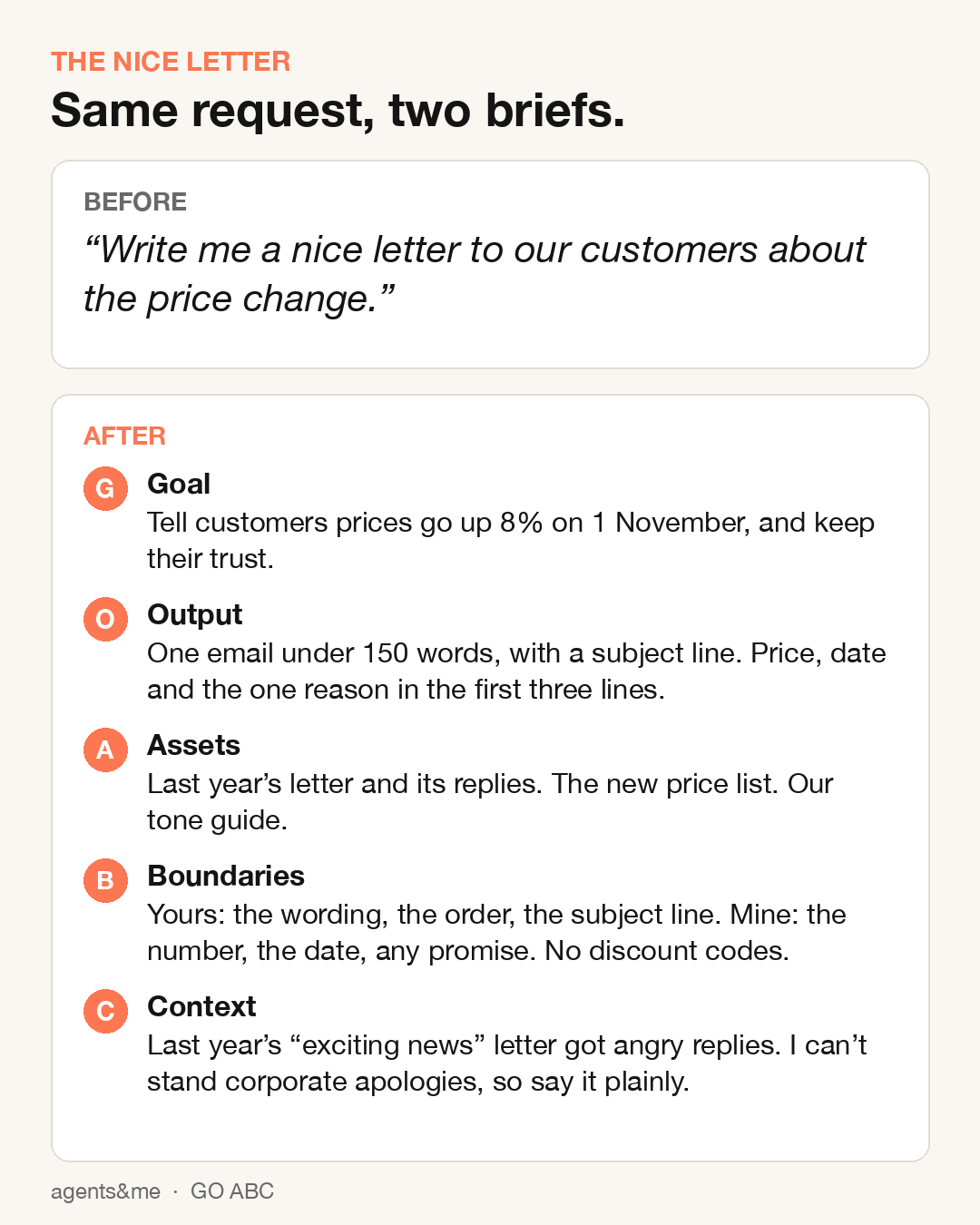
Before: “Write me a nice letter to our customers about the price change.”
After:
Goal. Tell our customers that prices go up 8% on 1 November, and keep their trust while we do it. It works if a customer finishes the letter knowing what changes, when and why, and doesn’t feel tricked.
Output. One email under 150 words, with a subject line. Done means the new price, the date and the one reason all appear in the first three lines.
Assets. Last year’s price letter and the replies it got. The new price list. Our tone guide.
Boundaries. Yours: the wording, the order, the subject line. Mine: the number, the date and anything we promise. No discount codes.
Context. Most of our customers have been with us for years and read everything we send. Last year’s letter opened with “exciting news” and the replies were angry. I can’t stand corporate apologies, so say it plainly.
“Nice” told the agent nothing it wasn’t already trying to do; the after says who reads it, what they need to know by line three, and what went wrong last year, which is the part only you know.
2. A product photo
Before: “Create a beautiful, premium photo of our new mug. Minimalist style, soft lighting, 4k, ultra realistic, trending on Instagram.”
After:
Goal. One hero image for Thursday’s Instagram launch post. Its job is to get a tap through to the pre-order page, and most people will see it as a thumbnail, so it has to read in one second.
Output. Four 4:5 portrait versions, one per light direction, so I pick by comparing instead of describing. Done is one mug, one light, one shadow, readable at thumbnail size.
Assets. Three reference photos for the look. What they share: one hard window light, a long shadow, raw materials, a lot of empty space. Take that, not their colors. The product photos are the truth: the glaze is grey-green, not blue, and the handle is the squared one.
Boundaries. Yours: background, surface, light, composition. Mine: anything that changes the mug. No logo and no text, we add those after.
Context. Our buyers are designers, and they scroll past anything that looks like a template. The template is steam, coffee beans, marble and eucalyptus, so none of those.
“4k, ultra realistic, trending” are magic words left over from 2023, and “trending” asks for exactly what everyone else is posting. The references do what the adjectives couldn’t, and because the banned props carry their reason in Context, the agent doesn’t start deleting every plant in the frame.
Every after is longer
You noticed.
The afters add no busywork. The steps they do add are checkpoints (four versions to compare, the key facts in the first three lines). Mostly they add the reason, the finish line, what’s true, the walls, and what a new hire would get wrong.
Every line in an after is one guess the agent no longer makes. A brief exists to remove the expensive ambiguity before the work begins. Pulling the lever again buys you another guess. A brief takes the guesses away.
And when a job repeats, the long answers move into files the agent reads every time. My brief to the team for this letter was two sentences: a pointer to the GO ABC file and our newsletter workflow, and “it’s gonna be our next issue, I want it to be online for the public.” It could be that short because this is the 47th issue:
Goal. Our next issue, public. (typed)
Output. The format, the length, the close. (in the workflow file)
Assets. The GO ABC file. (typed)
Boundaries. The team drafts, I press publish. (in a file)
Context. Who reads this, and what I never write. (in two files)
It still needed one correction. The team’s first draft opened on a story that showed off more than it taught, and the line my brief was missing sat in C: what I personally like or dislike. A new hire can’t guess that one, and neither could my team. Now it’s in a file too.
Files answer the jobs you repeat. A new job needs all five answers, typed, before anyone starts.
Your missing letter
Your first correction usually points at a line your brief was missing.
Open the last chat where you briefed an agent and scroll to the first thing you had to correct. Which of the five questions would have caught it? That’s your letter, and if the chat has no correction, try the one before it.
Then count how many of the five that brief left the agent to guess (a one-word answer counts as answered). Mine usually leave half of B.
The next time you brief an agent, write your letter’s line first. If it’s B, the line is “Yours: . Mine: .”
Then reply and tell me which letter was missing.
If you want to build your own agent team with me, the next workshops are 15, 16 and 22 October, in Hebrew: getagents.today.
That’s it for this week.
If this was useful, forward it to one person who asked an agent for “something nice” this week.
See you next week ✌️
-- Tom