

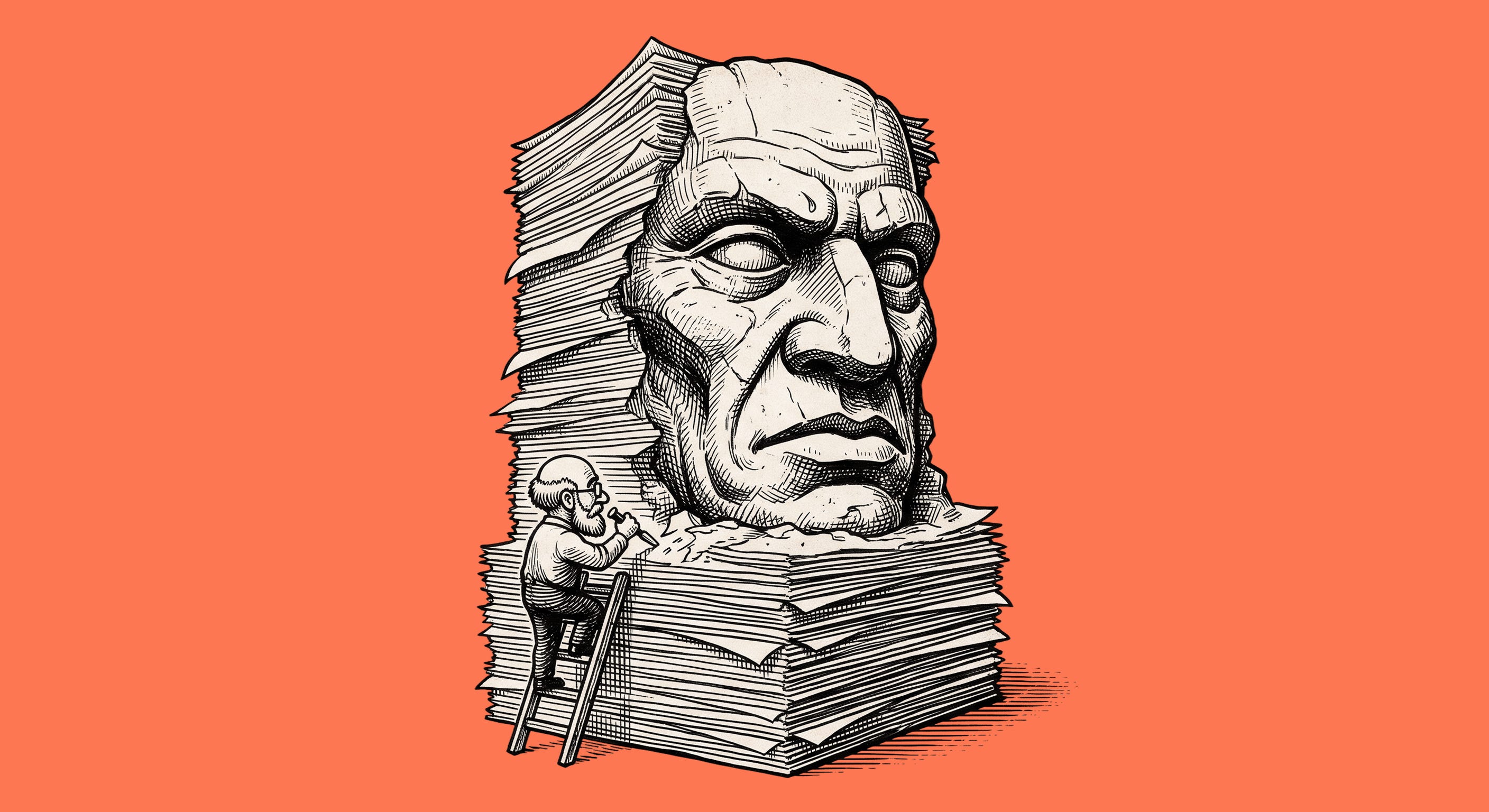
A friend called my named AI agents primitive god-making.
His argument, compressed and I think fairly: meet a force you don’t understand, give it a face and a name, start talking to it as if it hears you. Thunder becomes a god with a name. And the people doing it today with AI, he wrote, never looked behind the machine.
He’s half right, so I built a five-question test and ran it on my own team first, to test if they are just good prompt wearing a name tag or the real thing. Some of them failed.
The half he got right
The grifter is real. Somebody out there named a sales bot “James”, never once looked behind the curtain, and is charging clients for the feeling of knowing.
And yes, it’s a bit ridiculous, and it’s fun. My bookkeeper is called Koin. My security agent is called Hercules. Saying “ping Adam” instead of “invoke the operations agent that reads my inbox” saves me four words and a small piece of my sanity.
If the whole case for names were fun plus ergonomics, he’d win on points.
But he sent me somewhere he didn’t intend. Two weeks later I stopped mid-sentence in front of my own research agent, because I have the word “agents” in my company name and I wasn’t sure I could define it.
The word that ate itself
I’m not alone. Gartner predicts that over 40 percent of “agentic AI” projects will be canceled by the end of 2027, and they have a name for one of the reasons: agent washing, an old chatbot with a new label. Their analysts counted about 130 vendors selling the real thing, out of thousands selling the word.
So I went to the four companies whose models everyone actually uses, and read their own words.
Anthropic: “systems where LLMs dynamically direct their own processes and tool usage,” as opposed to workflows, where the path is written in advance.
OpenAI: “systems that independently accomplish tasks on your behalf,” and a simple chatbot, they add, is not one.
Google: “software systems that use AI to pursue goals and complete tasks on behalf of users.”
And xAI, the company behind Grok, never defines the word at all; its docs just describe the motion: decide whether to call a tool or answer, and keep going until you have enough.
Read them again and notice that each company describes the thing it sells. Anthropic sells the loop, OpenAI sells the labor, Google sells the rails. Strip the accents and one skeleton remains, which an Anthropic researcher named Hannah Moran compressed to eight words: “Agents are models using tools in a loop.”
A model, tools, a loop. Correct, and still useless the moment someone shows you a demo and asks: is this one?
So I turned it into five questions.
Does it loop? When a step finishes, does the system itself look at what came back and decide what to do next? A chatbot answers and waits for you. An agent notices the email bounced and tries a different address.
Does it have hands? Can it touch anything outside the conversation: files, your inbox, your calendar, a browser, code? Text in, text out is thinking. Hands are acting.
Does it have a trigger? Can it start without you in the room, tomorrow at 07:00, or the moment an invoice lands? This is the line between a tool you use and a teammate who shows up.
Does it have memory? Does anything it learned today survive into tomorrow, or does it wake up new every morning?
Does it have a mandate? Does it know, in writing, what it may do alone and what it must never touch without you?
The first two make it an agent, the next two make it autonomous, and the last one makes it safe to employ. All five, and you have something that deserves a chair at your team meeting.
Run it on the things you already use
Your plain ChatGPT or Claude chat: one out of five, maybe two. It remembers you now, it can search, and it still answers and waits.
Your custom GPT, your Gem, your Project: the same window with a job description. It knows who it is and what you need, and it acts on nothing.
And the sneaky one. Your Zapier-style automation has hands and a trigger, and it still isn’t an agent, because every step was chosen in advance by whoever drew the flowchart. Trigger plus hands, minus a loop, is a workflow, and that’s the most common costume in the industry right now.
I ran it on my own team
Some of mine pass with room to spare. Adam reads my inbox every night at 22:00, decides what each email needs, files the tasks, archives the rest, and reports back. Loop, hands, trigger, memory, mandate. Five out of five, earned.
And some of mine are, honestly, one good prompt wearing a name tag. If you can replace it with a single saved prompt and lose nothing, it was never an agent. It was a recipe.
What a name is actually for
The one who settled it for me isn’t mine.
Moti Friedman built an agent called Dana to help him and his siblings care for their widowed mother. Dana sits in the family Telegram group like another sibling, tracks who promised what, nudges until it happens, and holds whole conversations with mom in Yiddish.
Run the five questions on Dana and she passes every one. And the name fooled nobody in that family about what’s underneath. It let the siblings brief a teammate instead of operating a tool, and it gave a mother someone who is, in writing, 100 percent on her side.
The name changes nothing on the machine’s side of the screen. It changes the operator.
Don Norman wrote the book designers get handed in year one, and his point fits in a sentence:
“People don’t operate machinery, they operate the story of the machinery they hold in their head.”
“My COO Adam” is a story I picked on purpose, and I can show you every wire. I watch it happen in every workshop. The first agent people meet arrives with a default name, Adam, and most people keep him. Months later in the alumni group he is still Adam (one person renamed him Warren, which I respect), and not one of those people thinks he is alive.
The name did its only job: it turned the tool they were learning into the teammate they brief. And the people who brief a teammate, I’ve noticed, get the best work out of these things. The name is for the human. The mandate is for the machine.
Your turn
Take the thing you’ve built, or the thing you’re being sold, and ask the five questions: loop, hands, trigger, memory, mandate. Then tell me in the comments: your score, zero to five, and what you called it. No judgment on this side. Mine had recipes in the roster.
And to my friend, who knows exactly who he is: the argument continues, thank you for the mental challenge and for sending me down this fascinating rabbit hole.
See you next week ✌️
-- Tom
(the guy who made his own employees take a job interview long after hiring them)
P.S. This newsletter was 90% made by my AI team, including the one whose name it defends. Adam ran the review pass on that section and kept his notes strictly professional. I checked twice.
P.P.S. If you want to build your first one that passes three of the five questions, the next workshop is where I do it with you, live. The autumn dates are up at getagents.today.
P.P.P.S. I read every reply. The real me :)