

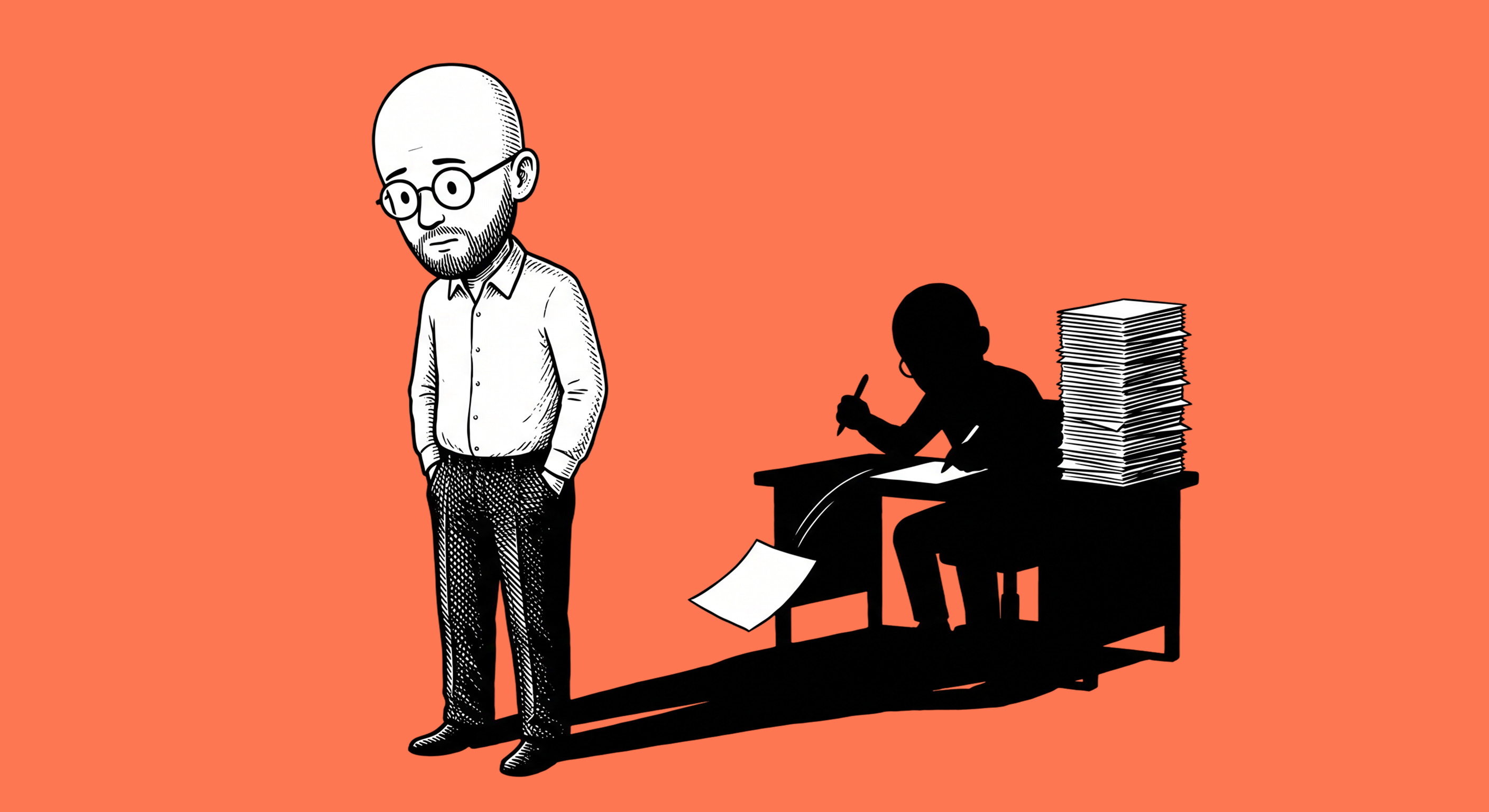
This month I got replaced. By someone I hired.
I asked Sabi, my design agent, to redesign my website with Fable 5.1. I have designed things my whole life, so I expected to get something 80% and start fixing.
Instead I sat in front of the page saying one sentence over and over, “How did I not think of that?!”
A better arrangement of the page, cleaner sections, sharper messages, copy I would have been proud to write.
It is not live yet, and I still have to compare the numbers (maybe the old page converts better, I do not know yet). But I know what I saw. I was watching a more experienced designer than me, and I had hired him.
Two feelings arrived in the same time: I was excited, because I run a company and I have always said I want my employees to be better than me. And I was scared, because now I know what that sentence costs when it comes true.
The fear, said plainly
Let me say the big one out loud.
I am afraid that in a few years every second person I know will be out of work.
I am afraid of what that does to a street, to a country, to a dinner table. Every few weeks I watch a new release land on a profession I know people in.
I do not have a number that makes that fear go away. Anyone who tells you they do is selling something.
The man building it asked for time
The man building one of the most capable models in the world published an essay asking his own industry to slow down. Dario Amodei, the CEO of Anthropic, wrote:
“we must slow the pace at which we improve the capabilities of AI models.”
And he committed his company to embedding outside evaluators inside it, with employee-like access, to check the work.
I read it twice. It is not a comfort, and it says nothing about your job or mine. But it is information. The speed of this is not weather. It is a decision, and the people making it are now arguing about it in public. That is more than we had in June, when I first wrote about the big change.
A message at ten past midnight
Someone who took one of my workshops wrote to me at ten past midnight. He runs marketing team abroad, and he types the way he talks, fast, in bursts.
His agents had rebuilt the brand and the website, moved the whole company to a new CRM, and written the guides for every team. Everyone in the organization now talks to an agent in Slack. He kept the name from the workshop, which made me smile.
I read it at six the next morning, because that is when I read things, and I asked the question I always ask, “How did the human employees react?”
“I fired the marketing designers”
He used to run a team like this with fifteen people, he told me. Today they are three, including him.
I looked at that for a while, then typed five words:
“I hear this too much 😢”
I added a sad face, which I do not normally use.
The part almost everyone gets wrong
So an agent did take a person. That is the sentence everyone will quote, and I am not going to pretend it away.
Now the sentence he wrote after it, which nobody will quote.
He spent a month working with a designers, building the design libraries properly, together with the agents.
Both are true. Nearly everyone stops at the first sentence, and the second is where the story lives.
The taste did not get automated. It got extracted.
A designer with a trained eye sat down for a month and moved what was in their head into something a system could hold: the rules, the type, what good looks like here and why. After that, the agents could produce at a standard a company puts its name on.
What disappeared was the production of the work. What became more valuable was the judgment that decides what good work is.
Sitting in front of Sabi’s page, it hit me that he could do that because I had spent a long time writing down what I like and why, in plain text files, for him and his teammates.
My taste was in files before it was in his hands. He did not replace me. He ran on me.
There is a difference between the designer in that story and me, and it is not talent. I own the files. That designer extracted a craft into a system that belonged to someone else.
Your judgment only counts if it lives outside your hands, written down and teachable. And it protects you only if it lives somewhere you own: your own notes, your own name, your own reputation for the thing. For most of us it does neither, and that is the most fixable problem in this whole letter.
Replace yourself first
Here is the exercise, and it takes 20 minutes.
What it buys you is not safety. It buys you the size of the thing. I have watched it in a room many times: a person sits down with a fear that fills the whole week, and stands up with a list of four tasks and one thing to protect. The fear is almost always bigger than the list.
Take a piece of paper and write down everything you actually produce in a normal week. Not your title or your responsibilities, the things that come out of you.
The deck, the report, the emails, the analysis, the follow up call, the thing you rebuild every Thursday and quietly resent.
Now sort them into three columns.
#1 Column one:
An agent could do this, and I could write the brief today.
This one is leaving. So automate it yourself, this month, and be the person who did it rather than the person it was done to. Those are two different people and everyone in the room can tell them apart.
#2 Column two:
An agent could do this, but only if somebody first extracted what is in my head.
This is your edge, and for almost everyone it is the biggest column by far. The extraction is the new job. Do it into something with your name on it.
#3 Column three:
I handed it to an agent with my best brief, twice, and it still was not right.
Not “I cannot explain how I do this.” Plenty of things you cannot explain, an agent does fine. The test is whether it survived a real attempt. Circle what did. It is usually the smallest part of your week, and it is the part to grow.
One warning before you grow it. Column three is not a hiding place. If you have not tried to hand something over, it is not in column three yet, it is in column two with a story attached.
What actually lives in column three
I have been thinking about this for a long time, and I have it down to 5 things. Not skills you can list on LinkedIn. Abilities. This is my bet, not a law, and the bet is that employers will pay their best people for these when the production of the work is gone.
Soft communication. The email that should be three lines today, to this person, because of what happened yesterday. The agent writes the perfect email. It does not know that today is not the day.
Decision-making in the middle of noise. Five good options, no clean data, someone waiting in the corridor. An agent will give you a better analysis than you can. It will not make the call and carry it, and the carrying is what people are paid for.
Taste. Sabi ran on my taste written down. But the person who looked at his page and knew, in one second, that it was better than mine, was still me. Taste you write down becomes a team. Taste you never write down becomes a job someone else gets.
Filtering. Agents produce more than any of us can read. Knowing which of the 40 outputs is the one, and which 39 to never mention, is now a full-time ability.
Emotional state recognition. The room, when the temperature changes. A client’s silence, a colleague’s “fine,” your own fear before it turns into an attack on someone else. No model is in the room. You are.
Notice what the list does not contain: hours. The one thing the agents beat all of us at is effort. If effort was your main tool, this column is where you build a new one.
If you are the one holding the budget
Run the same exercise on your team’s outputs. Not on your team’s people. That distinction is the whole job this year.
Then one piece of advice, the only one in this letter I would defend in an argument.
Extract before you cut.
The savings my graduate described had a prerequisite that will never make the post: a month of a designer’s expertise moved out of a head and into a system. Remove the craft before you have captured it and you did not buy speed. You bought a machine that produces fast, confident, mediocre work. And I would bet on a rebuild inside two years that costs more than the people did.
The companies that look brilliant in two years are not the ones cutting fastest. They are the ones extracting first and cutting second. From the outside, for the next few months, those two look exactly the same.
I do not know if I am on the right side of this
That is the honest ending and I am not going to dress it up.
I teach people to build these systems. Some go home and build something that gives them their evenings back. Some walk into an organization and 3 months later a designer is looking for work.
Same method, and I get both emails.
What I have, instead of an answer, is one thing that happened to me and not to someone else. I got replaced first, at the one craft I was surest of, by a teammate I hired and trained. And I am still here, with more work than before. Because the thing I had spent so long writing down turned out to be the thing that made him possible.
I only noticed this while writing. The three columns are not preparation for extraction. They are extraction. Twenty minutes with a pen, and the first page of what is in your head is out of your head, on paper you own.
I would rather you found that out with a piece of paper in your hand than in a meeting scheduled without you.
Three columns, 20 minutes. Start with the one you are avoiding.
That’s it for this week.
If this helped, forward it to someone who is quietly worried and has not said so out loud.
See you next week, or in the next workshop ✌️
-- Tom
(the guy whose design agent did a better job than him this month, and is still deciding how to feel about it)
P.S. This letter was harder to write than most. My agents did most of the building, as usual. The sad face was mine.
P.P.S. Dario Amodei’s essay: https://darioamodei.com/post/we-must-pace-the-frontier. The June piece this follows: The big change is here.
P.P.P.S. I read every reply. If you are in column three and cannot name what is in it, write to me. That is the interesting problem.