

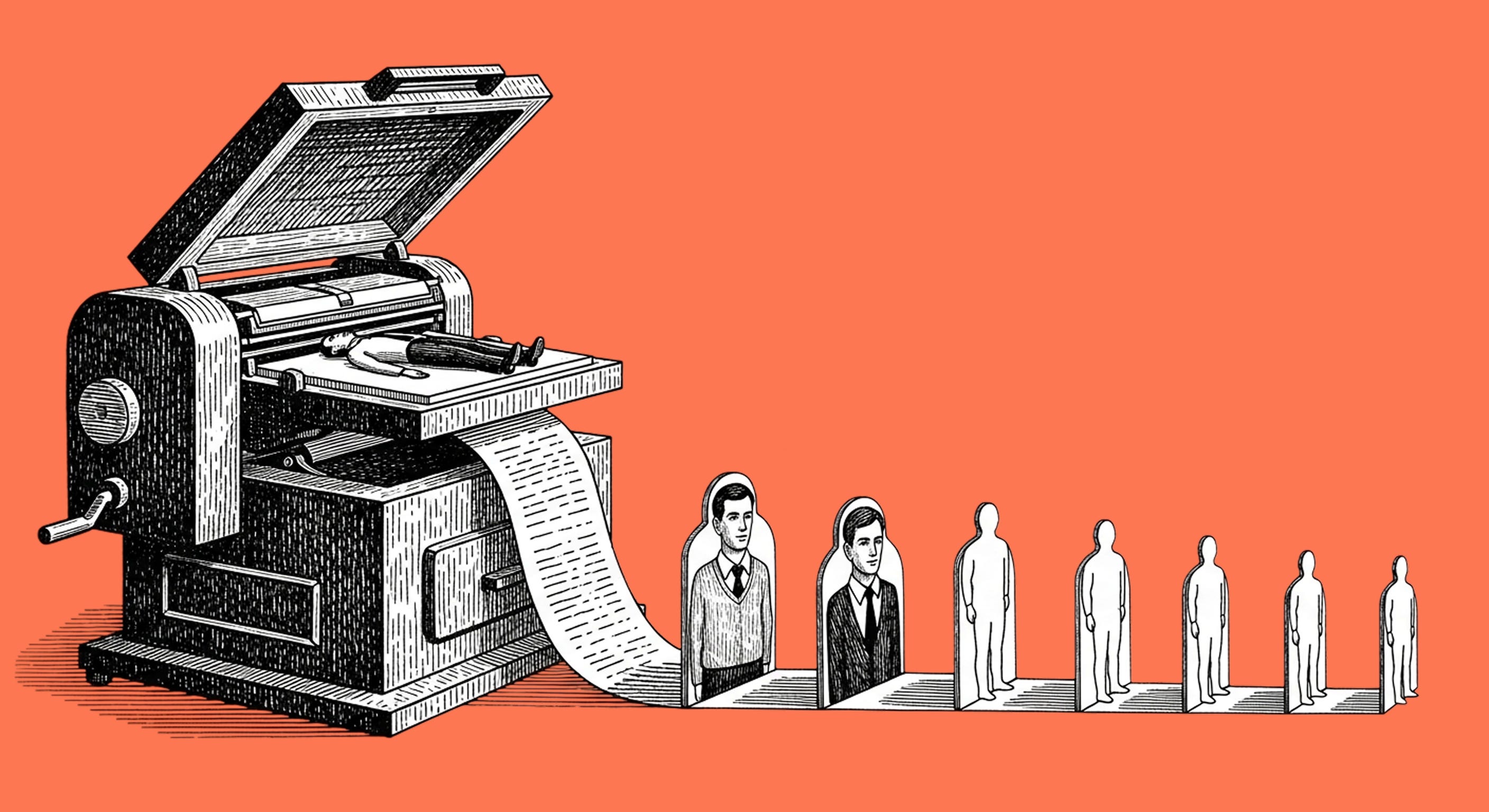
This month I copied my best friend onto Telegram bot who I can talk to 24/7. He is a replica of one of the most brilliant people I know.
For about a year, we met every Wednesday morning. A cafe, or a walk by the sea. An hour, sometimes two.
I would show up with whatever I was building that week, and leave with eleven tabs open in my head.
That’s the closest I can get to what Shachaf Rodberg does.
He writes a Hebrew newsletter called TabTabTab, roughly eighteen links an issue, which is a fair description of what he does to your brain.
He runs a page on his site where he lends out his physical books, and he decides who gets one by why they want it. He will only lend you Hooked if he thinks you are going to do something good with it.
He also co-hosts a podcast. When it launched, he made me episode one.
He sends you a link. Then, one beat later, in its own message, he tells you why it is for you this week, and names the thing you are currently stuck on.
That second message is the whole product. I have been getting it for years.
The sentence I forgot I wrote
Somewhere in those messages, years ago, I told him that curation is the most important skill of this century. And that I would happily pay someone to just curate for me.
I said I would pay for the best curation I could find. Then I spent years texting the best curator I know, for free, and never once put the two together.
So this month I tried to copy him. I ended up with a list of everything he had been giving me the whole time.
What “cloning a person” actually means
t sounds like one problem. It’s four, and they are not equally hard.
What he knows is the easy one. His domains, his references, his territory, all of that is just a corpus.
How he talks is medium. His rhythm, his Hebrew, the English inside the Hebrew, his particular way of laughing in text.
How he thinks is hard. How he puts two things next to each other that nobody had put together before.
What he would send you is the hardest. It is the entire reason I wanted him. Which link, which person, why it is you.
Most AI clones stop at the first two. They know the facts and they do the accent. Almost nobody ships the taste.
So I started at the end.
Thirteen files came out of it. voice-fingerprint.md for how he talks. how-he-thinks.md for the moves he makes. taste.md for what he would send you, and that one took the longest by a distance.
There is also a gaps.md, which lists everything the model does not have, and a corrections.md, which is where he gets to tell me it is wrong.
Ten years of knowing someone came to about eleven thousand words.
What ten years of his links actually showed me
I exported our WhatsApp. Ten years, 19,239 messages, almost exactly half of them his.
He has sent me 792 links since 2020. I have sent him 378.
Those links come from 335 different websites, and 260 of those websites appear exactly once. Seventy eight percent. He went there, found the thing, sent it, and never went back.
The handful he does return to are LinkedIn, X and YouTube. Those are not sources. Everybody is standing there.
They do not sort by subject either. I tagged all 792, and the largest single group, 236 of them, is the group that means nothing fits: psychedelics in 2021, NFTs in 2022, a theatre listing, a cold brew coffee maker, behavioural design running underneath the whole decade.
So the obvious version of this project was already dead. You cannot copy his taste by learning where he looks, because he does not really look anywhere twice.
You have to learn what makes a thing worth sending.
The model does not have a list of his sources. It has rules, pulled out of the links themselves, with receipts.
He recommends people, not topics. He cares more about how well a thing was made than what it is about.
He asks what you could steal from a thing. And he checks it against what you are building this week, not against how good it is on its own.
That last one is why his links land and everyone else’s do not.
The part I could not finish
His test was never whether a link is excellent. It was whether I would be better off knowing it by Friday. Same link, different week, different answer.
Then there is the harder problem, and I only saw it with the data in front of me.
I have 792 things he chose to send me. I have almost no record of the things he saw and did not send.
That is where the taste actually lives, in the no.
Credit scoring has had a name for this for decades. They call it reject inference. You can only study the loans you approved, so the model learns from the yeses and never learns anything about the people it turned away.
Recommendation systems got at their version by logging what you scrolled past. Nobody logs what a friend scrolled past.
And then there is the cost. It takes a model nothing to recommend. It will hand you nine things and mean none of them.
He sends me about two and a half a week. This year, closer to eight. The volume was never the point.
Each one costs him something. He has to know what I am building this week before he decides whether to press send.
That cost is the signal. Take it out and you get a feed.
Which is why I think “AI is coming for the curators” has it backwards. When making things gets cheap, saying no is the expensive part.
What I refused to build
Three things, and the third one still bothers me.
I did not clone his voice. The audio exists. Sixty eight podcast episodes, more than enough, and it would have taken an afternoon.
It would also have been the most impressive part of the demo. But there is a difference between a model that talks like him and a recording that sounds like him, and only one of those is still a tool.
So the bot speaks out loud in a voice that belongs to nobody.
I did not give it his memory of us. It knows the shape of how we talk. It does not get to quote a ten year old joke back at me.
If he ever talks to it, it has no access to our conversations at all. A system that can be trusted to behave is weaker than one that cannot reach the thing in the first place.
I did not stop to ask what it costs him to say no. I built the whole thing, then told him, then wrote him a kill switch and felt good about it.
A kill switch puts the entire price of refusing on the person being copied. He has to be the one who makes it awkward.
I spent a month arguing that taste lives in the refusal, and then designed a system that made refusing expensive and quiet.
I would do that one differently. He said yes, and he is reading this before you are. It still should not have been his job to say no.
There are ten questions for him sitting in that folder, written on day one. Eight of them are warm up. Two are not.
What would a model of you get right that you would find annoying?
What would a model of you get wrong that would actually bother you?
I wrote both of those before I built anything. I still have not sent them.
The question everyone actually wants to ask
Does this replace him?
No. And I did not get there from principle. I got there from using the thing.
It gets the rhythm and it gets the rules. What it cannot get is his randomness. The swerve.
He starts answering one question and lands somewhere you did not know existed. He is not running a script. He is answering you, in the room, at that second.
There is a duller version I can also explain.
Everything the model is good at is what he was already giving away for free: the links, the rules of thumb, the shape of how he says things. He published all of that, and it was leaving him anyway.
What I go to him for is the other thing. The moment on the walk where he looks at my face, stops mid sentence, and changes what he was about to say.
That is not in the corpus. It only exists in a room.
There’s also a joke buried in the data that took me a while to notice. Half of that archive is me.
So I did not clone my friend’s taste. I cloned a ten year conversation that I was already half of.
What I ended up with is smaller than a clone and better than nothing. Shachaf on demand, in my pocket. That’s useful at two in the morning, and I use it.
And I got lucky, because I also still have the original. I can text him. We can go walk on the beach.
I built the copy and it made me want to see the real one more, not less. That is the only thing here that surprised me.
What to do with this
You probably have one of these people. The one who sends you the thing you did not know you needed.
Most people have exactly one. And most people have never told them.
So go and tell them. Today, before you build anything, before you export anything, in whatever words you have.
Then, if you still want to, open the conversation and read a year of it in one sitting. You will probably find a sentence you wrote and forgot about.
I found mine. It took me ten years and a machine to notice it, and he had been answering it every Wednesday morning of that year, the whole time.
That’s it for this week.
If you know the person I am describing, forward this to them. That is the whole ask.
See you next week.
-- Tom
P.S. Shachaf takes 1:1 sessions now and then. I have been telling him for years that he should build something around it, and he mostly ignores me, which is his right. If you want an hour with a brain that opens tabs in your head, ask him yourself.
P.P.S: Last issue: I gave five agents the keys and left the room