

Here’s a small test to run before you ask AI for the next thing.
Guess a number: of the last ten images, posts or pages it made for you, how many look like one hand made them, at a level you’d sign?
Now check: put them side by side: thumbnails for images, the first two lines for writing, the first few seconds for video. If you only have six, six is fine. Keep both numbers, because I’ll ask for them at the end.
That row is where the problem lives. AI can make one great thing on a good day, and we judge each piece alone, on its day, so the drift never shows. Your reader sees the row, though.
Michelin has a sentence for this:
“An incredible meal could be a one-off experience. We’re after those restaurants that deliver the same standard every time.”
~ ~ ~
Some restaurants fall out of the running for exactly this reason:
“they might have one or two outstanding dishes, but others that aren’t quite as memorable.”
That’s most of what I see people making with AI. Mine included.
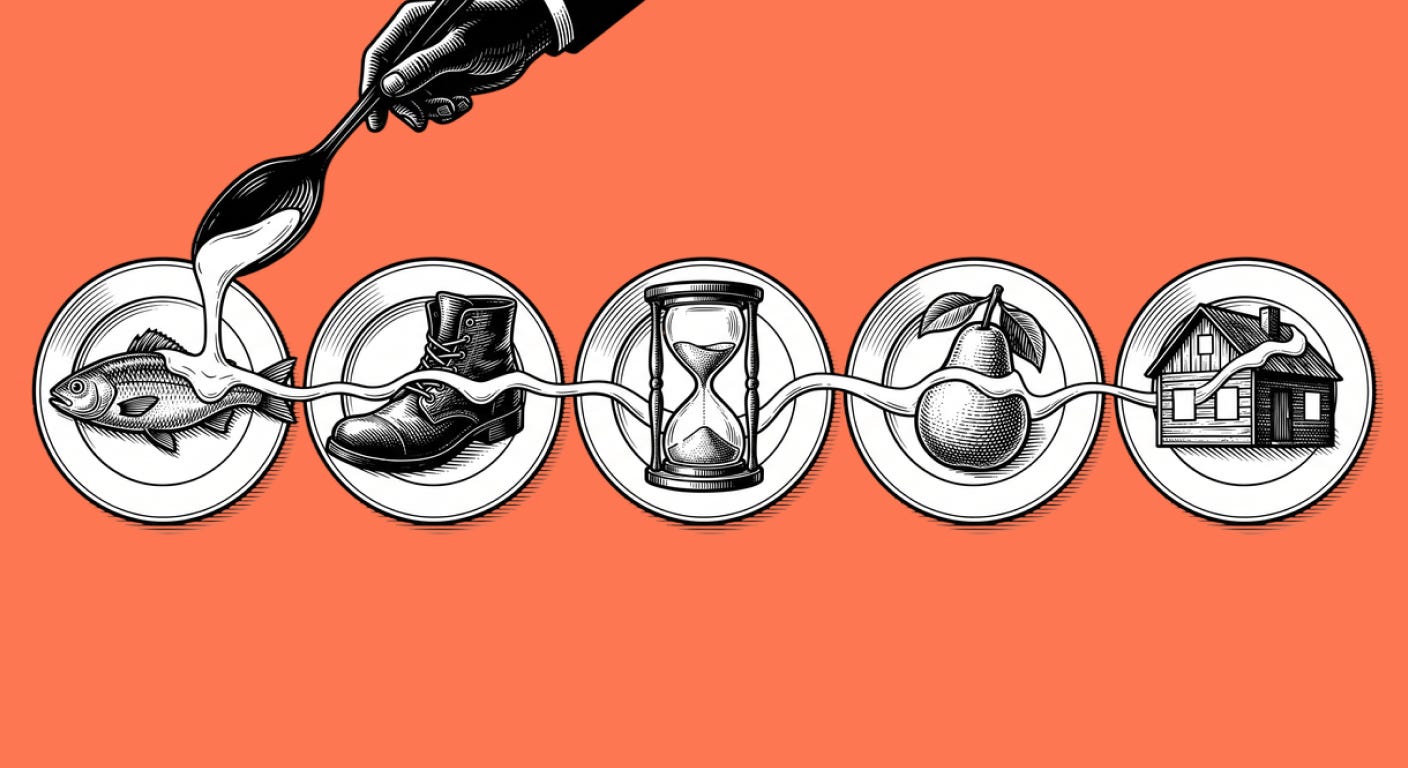
Michelin judges on five criteria, and two of them are this whole article.
One is “how the chef’s personality shines through their cuisine.”
The other, which it calls crucial, is “consistency across the entire menu and over time.” So that’s a hand and a level.
Its inspectors eat anonymously, and existing stars get reassessed year after year. As I read it, the kitchen never knows which night counts.
As far as I know, plenty of those kitchens keep changing what’s on the plate (not all of them, Michelin stars traditional cooking too), and I think you’d still know whose kitchen you were in. The menu changes and the hand doesn’t.
To me that’s a uniform language, and it’s what I’m trying to build now that we can all make something new every day. Here’s what has helped us so far on our covers, video, website and writing. I’m sure some of it is specific to us, and your language should look nothing like ours.
Before anyone cooks
Last issue I suggested showing your agent pieces you’d sign. Here, make a second pile: a few you wouldn’t. Then ask your AI what the first pile has that the second doesn’t.
One warning, if your ten already look alike. Ask whose kitchen it is. AI has a house style of its own, and ten pieces in that style are perfectly uniform and belong to nobody.
Then draw two columns: what never changes, and what changes every time.
In illustration, the first column might be colors, line and how much goes in a picture. The second is the subject.
In video, the first is how the camera moves and how fast you cut, and the second is the story. On a website it’s type, spacing and what color is allowed to do, and the second is the page. In writing, it’s how you open and the words you never use, and the second is the topic.
If you can’t say which column something belongs in, that’s probably the thing that’s drifting. These two columns are the document, by the way. Keep them on one screen.
Write the first column as instructions, because an adjective means something different to every model. “Friendly” becomes sentences under fourteen words that open on a person doing something. “Cinematic” becomes one camera move per clip, 2.5 meters forward, no zoom, no handheld drift. The test is whether a stranger could follow it without asking you anything.
Keep it in one file per craft, and if a second file has to exist, write at the top which one wins. Last month we counted seven design files, and they disagreed about our brand color. An agent follows whichever one it opens.
Anything that recurs, give the model a picture of it instead of a description. I’ll give you only my favorite failure here.
Our docs used to describe me in text so the covers could include me: bald, round glasses, beard, standing small. The model read that and kept drawing an elderly gnome, until I wrote to the team: “Let’s stop using the image of the old dwarf man... I’m 38 years old, not old :)”. Now I’m drawn from photos, and the prompt just says “the man”.
At the pass
The pass is the counter where plates wait before they go out, and where somebody looks at them one last time. Yours is the row.
Put the new piece next to your last five and read it through your two columns. If something in the first column moved, that’s drift, so fix it. If it stands out in the second, it might be tonight’s special, so leave it alone. Without the columns you’d send your best work back for being different.
Sometimes it’s both, and I don’t have a formula for that. In one of our films the model broke its own first-person rule and suddenly showed my face. My team logged it as a deviation, and I thought it was very beautiful.
I didn’t plan it. All I do now is ask, before calling something an error, whether it might be the best thing in the row.
The row also shows you how big something is. A check across 255 pages of our website found the same small phone problem on 249 of them (tap a button and it stays looking hovered). On one page that’s a slip, and across the site it’s a rule we never wrote.
A rule nobody has to open is a rule nobody opens, so put the check where you can’t skip it. We keep 45 camera moves in a file, and a small script now refuses any shot list that describes a camera move without naming one.
If you don’t write scripts, that’s fine. I think three yes or no questions, right before you publish, will do most of it:
Did anything in the first column move?
Would someone know this was mine with my name removed?
Would I sign it?
Ideally the person looking didn’t cook it. A fresh chat can do that, and if it’s just you, look at it tomorrow.
And the pass has a limit. All of this holds the floor, and it doesn’t set the ceiling.
In October one of my posts passed our review agent at 32 out of 45, with fixes, and I rewrote it anyway. The team’s draft had the argument. It didn’t have the silly nicknames I give the tools, or me making fun of myself in parentheses, and nothing on our checklist asks for that (I’m not sure anything could).
After service
Words break in strange ways, so keep a list of the traps. Ask our image model for a “poster” and it draws a poster hanging on a wall. That word is written down now, and nobody has to find it twice.
Then make someone read the list, which is the part we’re still bad at. We’ve logged 51 failures in one video ledger, and productions were still starting without opening it as late as September.
Then one day the oven changes.
When the image model we relied on was retired, the same words on the new one dropped all the white out of our pictures. Three covers went live that way before I noticed. (One is still up, and I really should deal with that.) We regenerated it, and the new version passed our automatic check and still looked brown to anyone with eyes, so the new version never shipped.
So keep a test menu: three subjects you know well. Run them on any new model or tool before real work, and put them in a row with the old ones.
You have two numbers by now, one you guessed and one you counted. Reply with them, like “guessed 7, got 3 of 10”. “Guessed 7, didn’t look” counts too.
See you next week ✌️
Tom
P.S. My team drafted this from our rule files and failure logs.
P.P.S. My next public workshops are in Hebrew, at getagents.today. Want one in English? Tell me that too.